 |
| Images from SOFIA's Facebook page. [The flight plan (bottom) has a glitch, the sharp spike to the left isn't real.] |
Monday, June 29, 2015
T+3 hours: Success!
Posting in a bleary-eyed haze is generally a bad idea, but I want to get the news out: last night's Pluto occultation was a success! Unfortunately several groups on the ground were clouded out, but others were able to obtain data and see an occultation, including the group aboard SOFIA. Read the SOFIA press release HERE!

T-7 hours: SOFIA is airborne!
Follow the flight in real time here!
This is the occultation flight! It's scheduled to be 8h 11m long. They'll fly to the southwest, then turn around and catch the occultation on their way back to Christchurch.
 |
| The flight status at the predicted occultation time. I love the wiggles to the south on the approach leg, designed to use up extra time and get SOFIA at the predicted point at the right time. Fingers crossed! |
 |
| At UT17:55, SOFIA has turned and is heading back to Christchurch for landing. |
Sunday, June 28, 2015
T-12 hours: The observing team at Mt. John in New Zealand
[posted for Jay Pasachoff]
 |
|
 |
|
Photo credit:Maryrose Fowlie, Mt. John University Observatory
T-1 day: SOFIA check flight
[posted for Michael Person]

Last night, we finished our check out flight on the SOFIA. There were some problems, and lessons learned all around, but we are confident for tonight’sflight that we’re as ready as we can be.
The flight crew practiced hitting our timing marks by introducing small maneuvers into the timing legs to adjust time where needed. The first one ended up with us hitting the mark several minutes off. Then they decided to go for the “aggressive” maneuvering plan. This second one hit our projected timing mark almost dead on according to the flight crew. So they’re having a lot of fun, but I’m definitely taking some airsickness meds tonight. Things got a little wobbly there for a moment during the aggressive maneuvering... ;-)
The flight crew practiced hitting our timing marks by introducing small maneuvers into the timing legs to adjust time where needed. The first one ended up with us hitting the mark several minutes off. Then they decided to go for the “aggressive” maneuvering plan. This second one hit our projected timing mark almost dead on according to the flight crew. So they’re having a lot of fun, but I’m definitely taking some airsickness meds tonight. Things got a little wobbly there for a moment during the aggressive maneuvering... ;-)
SOFIA preparing for Twilight Check Flight Takeoff:

T-1 day: Mt. John preparations
[posted for Stephen Levine]
I had a chance this morning to walk along the south side of Lake
Tekapo. The weather was clear and windy (as it would be for most of
the day). In the afternoon, I drove up with Rob, and we got POETS
sorted out and ready for Jay and Bryce to install. Then I went over
to the OC61 and setup the near IR camera. The day was windy, with
average wind speeds over 60kph and gusts up to over 100kph. The wind
did not abate much after sunset, and later clouds moved through as
well.
Tekapo. The weather was clear and windy (as it would be for most of
the day). In the afternoon, I drove up with Rob, and we got POETS
sorted out and ready for Jay and Bryce to install. Then I went over
to the OC61 and setup the near IR camera. The day was windy, with
average wind speeds over 60kph and gusts up to over 100kph. The wind
did not abate much after sunset, and later clouds moved through as
well.
 |
While walking along the south shore of Lake
Tekapo, I saw this group of gulls sitting on a rock in Lake Tekapo.
Mt John is behind them, and the observatory buildings are visible on
the ridge line.
|
 |
Looking west from the OC61 dome a bit
after sunset. This was one of the few pictures not blurred out. To
get this, I was facing into the wind, which was about 60 to 70 kph.
|
 |
Readout from the Mt. John weather station. For
much of the late afternoon and evening,
the wind was variable out of
the west, between about 60 and 80 kph,
and peaking over 100 kph.
|
 |
An enticing sign at the start of the trail
from Lake Tekapo to the summit of Mt. John.
|
 |
Sign at the start of the trail from Lake Tekapo to Mt. John.
 |
The 61cm Optical Craftsman telescope. The near IR
camera that Henry Roe lent us is the blue box mounted at the back end
of the telescope.
|
T-1 day: Almost Ready
[posted for Chris Stockdale]
 |
| Luke connects up the PICO camera to the telescope |
 |
| Steph ponders the GPS cables |
 |
| Steph & Luke review the MaximDL settings |
T-2 days: Cloudy to clear(ish)
 |
| The stars of Sagittarius (center) and Capricorn (upper left) peek through clouds in Flagstaff. |
Discouraged by the weather, I set to work on looking at last night's astrometric data to see what the updates to the occultation path might be. In the middle of this work, I had a scheduled call with folks on SOFIA on their test flight, to test communications for tomorrow night when we'll send email and call on the satellite phone to give a last-minute prediction update. As I stood out in the middle of the street (bad cell reception in the house), talking to people in a 747 flying over the ocean south of New Zealand, I looked up and saw the four stars that make up the handle of the Sagittarius teapot asterism. Definitely a welcome sight, as it means that Pluto is near (its location is marked by a green circle in the image above, but Pluto itself was not captured here).
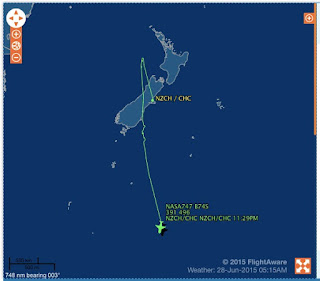 |
| See SOFIA's flight path on FlightAware |
I came back in to find emails from observers at all four telescopes saying they got at least some data tonight! That's a lot more than I was afraid we might get, given the weather today and tonight. Now on to data analysis!
Subscribe to:
Posts (Atom)